On this page
- How much concrete do I need for a slab?
- Worked example: what does that look like in practice?
- What does a concrete slab calculator leave out?
- How do you calculate concrete for a slab properly?
- Does the sub-base change the concrete volume?
- How much extra should you allow for waste?
- Does a concrete floor calculator work for waffle pods?
- What happens if you order too little?
- When is a concrete volume calculator not enough?
- Which Australian calculators get it wrong?
- Frequently asked questions
If you are asking how much concrete do I need, the answer starts with one multiplication: length times width times depth, in metres. That gives cubic metres, and cubic metres is what you order. A concrete slab calculator will do that arithmetic for you. What no calculator does is account for the four things that make the real order larger.
At a glance
- Volume is length x width x depth, in metres
- A 100mm slab needs 0.1 m³ for every square metre
- Calculators ignore fall, edge beams, sub-base variance and wastage
- Ordering short costs more than ordering slightly over
- Always measure the prepared sub-base, not the drawing
How much concrete do I need for a slab?
Measure length and width in metres to get square metres, then multiply by the depth as a fraction of a metre. A 100mm slab is 0.1, a 125mm slab is 0.125, a 150mm slab is 0.15.
The result is the theoretical volume of a perfectly flat rectangular slab with vertical edges on level ground. That is your starting point, never your order.
Worked example: what does that look like in practice?
A shed slab 6 metres by 4 metres at 100mm. The area is 24 square metres. Multiplied by 0.1, the volume is 2.4 cubic metres. A concrete calculator returns 2.4 and stops there.
A driveway 12 metres long and 4 metres wide at the same depth. The area is 48 square metres, so the volume is 4.8 cubic metres. Same depth, double the area, double the concrete. That is the one part of this that behaves exactly as expected.
For coverage the other way: at 100mm, one cubic metre covers 10 square metres. At 125mm it covers 8. At 150mm roughly 6.7.
What does a concrete slab calculator leave out?
Four things, and all four are legitimate.
Fall. Slabs are poured to drain, so the low side is deeper than the high side and the average depth exceeds the nominal depth.
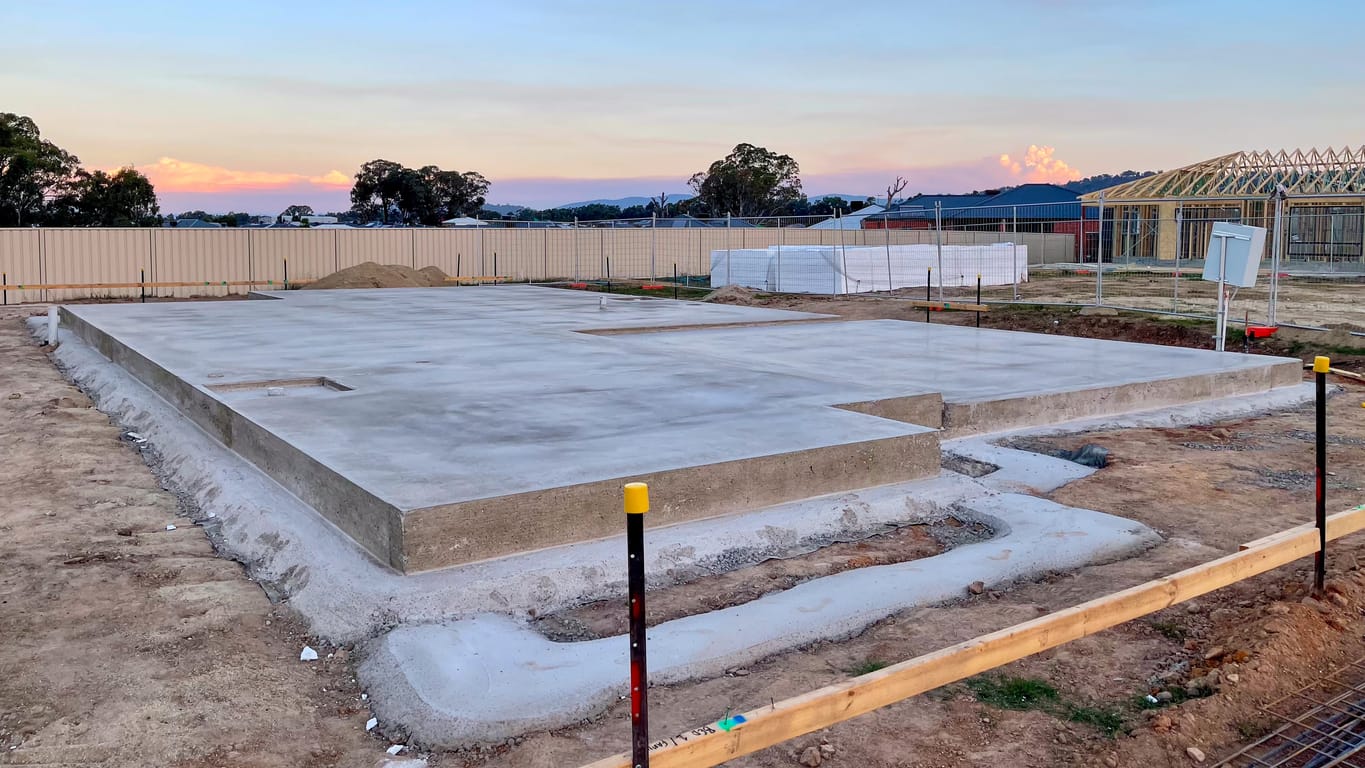
Edge detail. A thickened edge beam or a step-down consumes concrete a uniform-thickness calculation does not see.
Sub-base tolerance. Excavation is never millimetre accurate, and a base prepared within 20mm across a large area both adds and removes concrete in places the drawing does not show.
Wastage. Concrete spills during placement, some remains in the pump or chute, and it is sold in fixed load sizes rather than the exact figure you calculated.
How do you calculate concrete for a slab properly?
Work in this order. Measure the prepared and compacted sub-base at the corners and the centre. Confirm the fall direction and how far the low side drops. Add every edge detail: thickened beams, steps, rebates and aprons. Then apply a waste margin.
A concrete slab material calculator gives you the geometry. Measuring the ground is what determines whether the order is right. Our guide to what happens during a concrete pour shows where preparation sits in the sequence.
Does the sub-base change the concrete volume?
Only where the sub-base is not where it should be. A correctly prepared and compacted base keeps the concrete at the specified thickness. A low or uneven base either swallows extra concrete or leaves the slab thinner than designed.
The second outcome is worse. A slab thinner than specified in places cracks and breaks down at the thin sections, and replacing it costs far more than the concrete that was saved. Our guide to slab thickness for a shed covers how depth, sub-base and reinforcement depend on each other.
How much extra should you allow for waste?
Size the margin to the job rather than applying a fixed percentage. A flat, well-prepared, single-level rectangle needs very little. A job with fall, multiple levels, thick edges or uncertain sub-base needs materially more.
This is a judgement made by whoever has seen the ground, which is why it should not be made by a web form. If you are pricing bags, a bags of concrete calculator converts volume to bag count, but it inherits every one of the same blind spots.
Does a concrete floor calculator work for waffle pods?
Not directly. A concrete floor calculator assumes the full depth is concrete. A waffle pod slab displaces a large proportion of that volume with polystyrene pods, so the concrete actually placed is far less than the footprint depth suggests.
The overall depth still has to meet the engineered design, which is why waffle slabs are specified rather than calculated from a formula. Our raft versus waffle pod comparison explains how soil classification drives that choice.
What happens if you order too little?
You stop pouring, the surface sets while you wait, and you finish with a cold joint across the slab. That joint is a permanent weak point and a permanent visual defect, and it cannot be finished out afterwards.
The alternative is a second delivery with a second minimum load charge, a second mobilisation and a crew standing idle. Both outcomes cost more than the extra cubic metre would have. Our concrete removal and disposal guide covers what happens to material that does not end up where it was intended.
When is a concrete volume calculator not enough?
As soon as the job stops being a rectangle on level ground. Multiple levels, integrated steps, curved edges, rebated borders and significant fall all need measured take-off rather than a formula.
It also fails on small jobs where load structure matters more than volume. Concrete is priced in bands and small quantities attract a higher rate per cubic metre, so past a point the next increment up costs less than a second delivery. No calculator models that, but our guide to concrete slab cost in Sydney does.
Which Australian calculators get it wrong?
The comparison comes down to one question: does it ask for anything beyond length, width and depth. A tool that also asks for fall, edge detail and waste allowance lands closer. One that asks for three numbers will not.
Use a concrete slab estimator to sense-check, then have the prepared sub-base measured.
Frequently asked questions
How many square metres does a cubic metre cover?
At 100mm, 10 square metres. At 125mm, 8. At 150mm, roughly 6.7.
How many bags of concrete do I need for a slab?
Divide your volume in cubic metres by the yield printed on the bag. Beyond a small pad, bagged concrete becomes impractical on labour alone.
How do I work out how much concrete I need for an odd shape?
Break it into rectangles, calculate each separately and add them. For curved edges, average the widest and narrowest points and add a larger margin.
Can I order exactly the calculated volume?
You can, but the calculation is theoretical and the ground is not. The margin exists for a reason.
Does a pump change the quantity?
Yes. Concrete left in the pump line is bought and not placed, so pumped jobs carry wastage a direct chute pour would not.
Does a concrete calculator au tool match what a concreter orders?
Rarely. The tool does the arithmetic correctly and then stops before the parts that matter.
Not sure how much concrete your job needs? Request a quote and we will measure the prepared sub-base rather than estimate from a drawing. Call 02 9054 3040, or check coverage on our areas serviced page. Shed and garage slabs are covered on our shed slab service page.
Licensed Sydney concreters pouring residential, commercial and council concrete since 1999. Every job is worked to engineer-certified specifications by our own crew.
NSW Fair Trading Lic. 219967c · ABN 13 160 436 902 · Fully insured