On this page
- What are the main types of concrete garden edging?
- Why does machine-cut edging look different?
- What is the difference between concrete edging and a mowing strip?
- Where does concrete garden edging work best?
- How deep should concrete edging go?
- Does concrete edging need reinforcement?
- Can concrete edging be coloured or textured?
- How does edging tie into paths and driveways?
- How long does concrete garden edging last?
- Frequently asked questions
Concrete garden edging does one job that nothing else does as well: it holds a clean line between garden bed and lawn permanently. Timber rots, steel rusts and plastic lifts. Concrete, done properly, stays where it was put.
At a glance
- Machine-cut edging is poured continuously on site for a seamless line
- Poured-in-form edging suits straight runs and larger sections
- Precast sections are faster but show joints
- The finished look depends on the cutting technique, not just the mix
- Edging also defines who maintains what
What are the main types of concrete garden edging?
Machine-cut edging, also called continuous or extruded edging, is poured in a continuous run through a moving form. It produces an unbroken line with no joints and is the most common choice for curved garden beds.
Poured-in-form edging is placed in fixed formwork, usually in straight runs, and finished by hand. It suits defined geometric layouts and larger sections.
Precast edging is manufactured off site and installed in sections. It is fast and consistent, but sections show joints and can shift individually over time.
Why does machine-cut edging look different?
Because the line is continuous. There are no joints to open, no sections to settle independently, and no visible repetition. On a curved bed, a continuous pour follows the curve as a single element rather than approximating it with straight sections.
The finish also matters more than people expect. A smooth trowelled top with a clean vertical face looks deliberate. A rough top with an inconsistent face looks like a concrete strip in a garden.
What is the difference between concrete edging and a mowing strip?
Concrete edging is the boundary element. A mowing strip is a flat band of concrete at ground level wide enough to run a mower wheel along, so the lawn edge does not need trimming.
The two are often combined. A mowing strip with a slight raised edge behind it gives you both the clean cut line and the physical separation between bed and lawn.
Where does concrete garden edging work best?
Along lawn and garden boundaries where the line matters. Around established trees and beds where a timber or steel edge would need replacing. Along a driveway or path edge to keep gravel or mulch from migrating onto the hard surface. Between a lawn and a garden bed on a slope, where other edging types wash out.
It works less well where the ground is actively moving, since a rigid edge has no tolerance for settlement. On unstable ground, a flexible edge tolerates movement better.
How deep should concrete edging go?
Deep enough to hold the line and to sit below the level that cultivation or mowing will disturb. Edging that stops at the surface lifts and tips over time, which is the most common failure.
Depth also has to accommodate whatever sits behind it. A raised bed retained by edging needs the edging designed to hold that soil, which is a different requirement from a flush mowing strip.
Does concrete edging need reinforcement?
For standard garden edging, generally not, because the loads are minimal and the sections are short. Where edging retains soil or spans a gap, reinforcement or a deeper section is warranted.
Can concrete edging be coloured or textured?
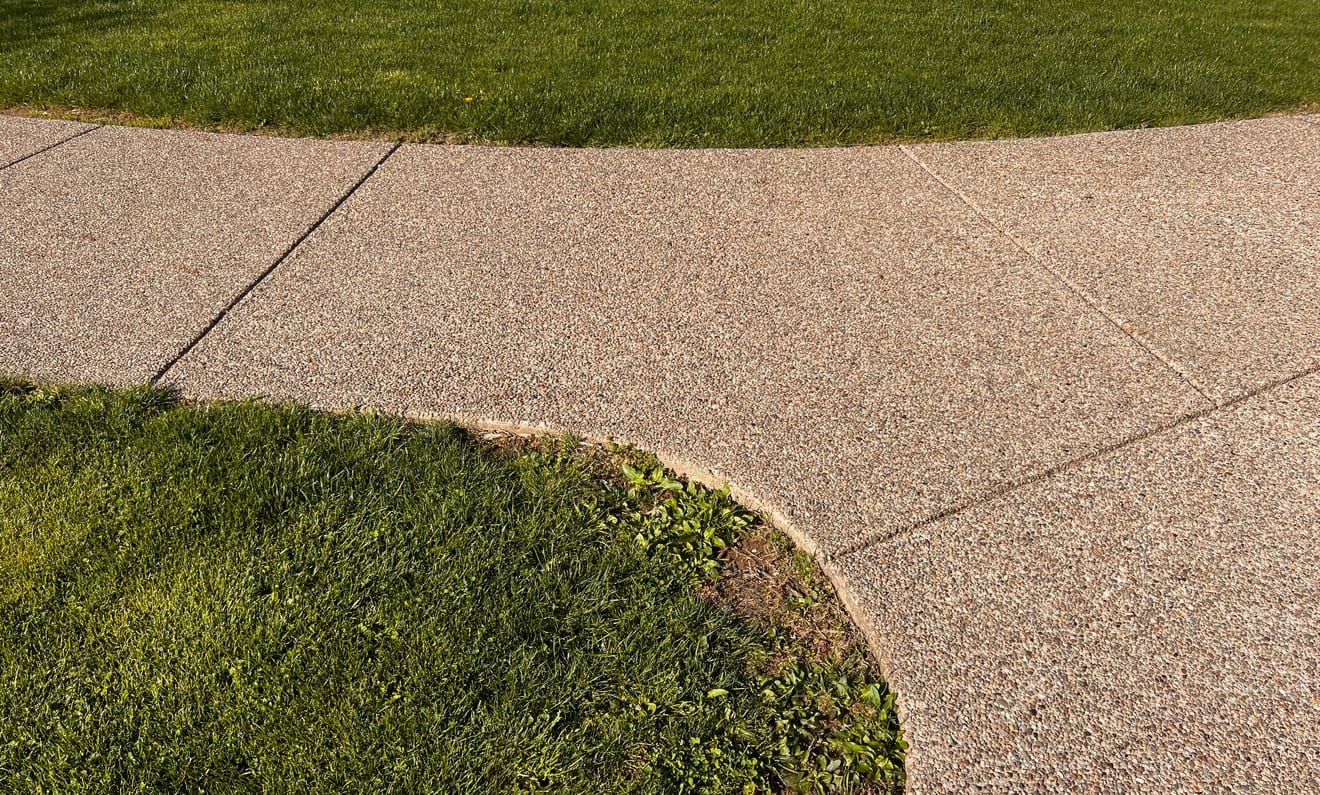
Yes, and this is where edging can either blend in or stand out. A plain grey edge is the default. Oxide through the mix, an exposed aggregate finish or a stencil pattern all change the look and cost.
Our post on exposed aggregate for driveways covers that finish, and the same principle applies to edging where a texture change defines the line.
How does edging tie into paths and driveways?
Ideally as one design rather than two. Edging set adjacent to a path should line up with the path edge, share a level strategy and, where the path is poured, be considered at the same time so the joint detail is deliberate.
Our concrete pathways page covers the flatwork side, and our post on concrete paths covers the design considerations.
How long does concrete garden edging last?
Decades, if the base is prepared and the line is deep enough. The failure mode is almost always installation rather than the concrete itself: shallow sections tipping, poor base preparation allowing settlement, or a mix that is too dry to consolidate.
Frequently asked questions
Is concrete edging better than timber or steel?
For permanence, yes. Timber rots and steel corrodes, both needing replacement. Concrete does not.
Can concrete edging be curved?
Yes, and continuous machine-poured edging handles curves better than precast sections.
How wide should a concrete mowing strip be?
Wide enough for a mower wheel to run on comfortably without slipping off into the bed.
Can edging be added without disturbing an established garden?
Usually yes. The main disruption is access for equipment and the spoil from the trench.
Does concrete edging stop weeds?
It reduces them at the boundary because it removes the loose edge where weeds establish. It does not eliminate them.
Can I pour edging myself?
Physically yes for short straight runs. Getting a consistent line, a smooth top and adequate depth is harder than it looks, which is the argument for machine-cut.
Want clean permanent garden lines? Request a quote or call 02 9054 3040. Our driveway page and pathways page cover the flatwork that edging usually adjoins.
Licensed Sydney concreters pouring residential, commercial and council concrete since 1999. Every job is worked to engineer-certified specifications by our own crew.
NSW Fair Trading Lic. 219967c · ABN 13 160 436 902 · Fully insured