On this page
Your soil classification determines whether your new build needs a raft slab or a waffle pod slab – and your structural engineer confirms it after reviewing your geotechnical report. The raft slab vs waffle pod slab debate is not really a debate at all once you understand the system behind the decision. This guide explains how that system works, what each slab type actually is, what common questions homeowners and builders have about both, and how cost compares across Sydney sites.
Your Soil Classification Is the Starting Point
Australian Standard AS2870 classifies residential soil into five reactivity categories based on how much the ground moves with moisture changes. The more reactive the soil, the more the ground shifts when it gets wet or dries out, and the more robust the slab system needs to be to handle that movement without cracking.
A and S class soils are sandy or low reactivity. Minimal movement is expected and a waffle pod slab is generally suitable.
M class soil shows moderate reactivity and is the most common classification across Sydney’s established suburbs and new estates. A waffle pod slab is typically used on M class sites, though some sites will warrant a stiffened raft slab depending on the specific conditions found in the geotechnical report.
H class soil – which includes H1 and H2 designations – is high reactivity. Significant ground movement is expected and a raft slab is the standard specification for these sites.
E class soil has extreme reactivity and typically requires a raft slab with deep piers to achieve the stability the structure needs.
In western Sydney’s newer housing estates – Marsden Park, Box Hill, Riverstone, Schofields and Oran Park – the majority of residential sites sit on M class soil. This is why waffle pod slabs dominate new estate construction in this region and why most builder standard inclusions in these areas are priced on a waffle pod specification.
What Is a Raft Slab and When Is It Required?
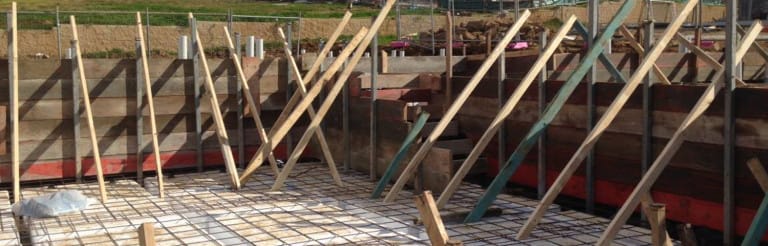
A raft slab is a single monolithic reinforced concrete slab poured directly on prepared ground. Edge beams and internal stiffening beams are cast as part of the one pour, giving the slab the rigidity to move as a single unit when the soil beneath it shifts. The name reflects the structural principle – the house floats on top of reactive soil the way a raft sits on water, absorbing ground movement without fracturing.
A stiffened raft slab – sometimes called a conventional raft – is the most commonly specified raft slab for residential construction in NSW. The stiffening beams run in a grid pattern through the slab, providing rigidity across the full foundation area. This is the configuration your structural engineer will typically specify when a raft slab is required on reactive H or E class sites.
Raft slabs require excavation because the beams are formed into the ground. They use significantly more concrete and more steel reinforcement than a waffle pod slab. The result is a stronger, heavier foundation that costs more and takes longer to install – but on H class or E class sites, the raft slab vs waffle pod slab comparison is not a genuine choice. The soil conditions demand a raft slab and the engineer will specify one.
Do raft slabs require footings under load bearing walls?
In most residential raft slab designs, the stiffening beams that run beneath load bearing walls serve the same structural function as separate footings. Your structural engineer’s drawings will confirm the beam depth and reinforcement required under each load bearing wall position. Never assume the standard beam layout covers all load bearing positions without checking the drawings.
What Is a Waffle Pod Slab and Where Does It Work?
A waffle pod slab uses polystyrene foam pods laid in a grid on a compacted sand base, with concrete poured around and over them. The pods create voids in the underside of the finished slab – producing the waffle pattern that gives the system its name. No excavation is required. The entire slab sits on a prepared surface, which makes it faster and cheaper to install than a raft slab.
The pods reduce the volume of concrete needed without compromising the structural performance of the slab on stable or moderately reactive soil. For M class and lower classifications, a waffle pod concrete slab delivers the structural performance required by AS2870 at a meaningfully lower cost than a raft slab. This is why waffle pods became the default residential slab across much of NSW and continue to be the most commonly poured slab type on new builds across Sydney’s growth corridors.
Are waffle pod slabs good?
Yes – when specified and poured correctly for the right soil conditions, a waffle pod slab is a sound, durable residential foundation. The criticism waffle pod slabs attract is almost always the result of the wrong specification for the site, not a failure of the system itself.
Can a waffle pod slab crack?
Any concrete slab can crack. Waffle pod slabs are more susceptible to cracking than raft slabs when the soil beneath them experiences unexpected movement – which is why soil classification and accurate geotechnical reporting matter so much before the slab is specified.
Can waffle pod slabs be used for two storey buildings?
Yes. Waffle pod slabs are regularly used for two storey homes on suitable soil classifications. The engineer specifies the beam depth, reinforcement and pod layout based on the loads the structure above will place on the slab. A two storey home on M class soil does not automatically require a raft slab.
Does a waffle pod slab need piers?
Piers are required when the geotechnical report identifies soil conditions that a standard waffle pod or raft slab cannot adequately manage – typically E class sites or sites with deep reactive clay below the standard beam depth. Piers are not a standard requirement on most residential waffle pod slabs in NSW.
How long does a waffle pod slab take to cure?
Standard concrete curing time for a residential slab is seven days minimum before framing can commence, though full strength is reached at 28 days. Your builder and building certifier will confirm the minimum cure time required under your project’s specific conditions.
Waffle pod slabs also come in different specifications depending on the soil classification. An M class waffle pod slab and an H class waffle pod slab have different beam depths, pod configurations and reinforcement requirements. The geotechnical report drives not just the choice between slab types but the specific configuration within whichever type is chosen.
How Cost Compares Between the Two
Are waffle pod slabs cheaper than raft slabs? Yes, in almost every scenario. Raft slabs require excavation, more concrete and more steel reinforcement. They take longer to form and pour. On H class sites where a raft slab is the only suitable option, the higher cost is unavoidable.
On M class sites in Sydney, approximate cost ranges for a standard single-storey residential slab sit between $8,000 and $14,000 for a waffle pod slab and $12,000 to $20,000 or more for a raft slab. Block size, access constraints, beam depth required by the engineer’s specification and mobilisation costs all move these figures.
The key variable is always the geotechnical report. A site with deeper reactive clay will carry a higher specification and a higher cost regardless of which slab type is ultimately poured. Never accept a slab quote from a builder who has not confirmed the soil classification – because if the specification turns out to be wrong, the cost of rectification will far exceed any savings made at the quoting stage.
Are Waffle Pod Slabs Banned in Australia?
No. Waffle pod slabs are not banned in Australia.
This question circulates regularly and the confusion stems from discussions in some states – particularly Victoria – about tightening the requirements around soil testing and engineering sign-off before a waffle pod slab is approved. Some local councils and state building authorities have added requirements to ensure the soil classification is properly confirmed before a waffle pod specification is accepted.
In NSW in 2026, waffle pod slabs remain fully permissible and are the most commonly poured residential slab type. The requirement is that the soil classification must be supported by a geotechnical report and the slab must be designed to meet AS2870 for that classification. The problems that generate headlines about failing waffle pod slabs are almost always about a waffle pod being poured on a site that should have had a raft slab, or a correctly specified slab being poured to a lower standard than the engineer required.
Who Makes the Call: You, Your Builder or Your Engineer?
Neither you nor your builder decides between a raft slab vs waffle pod slab – your structural engineer does, after reviewing the geotechnical report for your specific block. Your role is to make sure the soil test happens before the slab is specified. Your builder should not be quoting a waffle pod without confirmation of the soil classification.
If your site is on flat, prepared land in one of Sydney’s new estates, the likelihood is that M class soil will support a waffle pod specification. If your block has clay-heavy soil, sits on a slope or is in an area with a history of ground movement, expect your engineer to lean toward a raft slab – and expect the quote to reflect it.
The Point That Matters Most
The raft slab vs waffle pod slab comparison comes down to one practical principle: pour the slab your engineer specifies, to the specification they provide, with quality materials and an experienced crew.
A waffle pod slab on an M class site, poured correctly, is a sound residential foundation. A raft slab on an H class site, poured correctly, is also a sound foundation. The failures that generate expensive rectification work trace back to two causes – the wrong slab type for the soil conditions, or the right slab type poured to a lower standard than specified.
KMA Concrete Constructions has been pouring raft slabs and waffle pod slabs across greater Sydney since 1999. Every residential slab pour is worked to engineer-certified specifications.
Licensed Sydney concreters pouring residential, commercial and council concrete since 1999. Every job is worked to engineer-certified specifications by our own crew.
NSW Fair Trading Lic. 219967c · ABN 13 160 436 902 · Fully insured