
On this page
- What Happens the Day Before?
- Site Arrival and Setup
- Reinforcement and Form Check
- Concrete Ordering and Delivery
- Pumped vs Chuted Concrete
- Placing the Concrete
- Vibrating and Consolidating
- Screeding and Levelling
- Surface Finishing
- After the Pour — Curing and Protection
- When Can You Use the Concrete?
- Frequently Asked Questions
On the day of a concrete pour, the crew sets up the site, checks the forms and reinforcement, orders and receives the concrete, pumps or chutes it into the forms, vibrates and screeds it to level, and finishes the surface to the specified texture. The whole process for a residential driveway or slab typically takes four to six hours. You do not need to be there but it helps to have site access sorted beforehand. KMA Concrete Constructions handles residential and commercial pours across Greater Sydney — call 02 9054 3040.
What Happens the Day Before?
A concrete pour does not start on the morning of the pour. The site preparation that happens in the days before the pour determines whether the day itself runs smoothly.
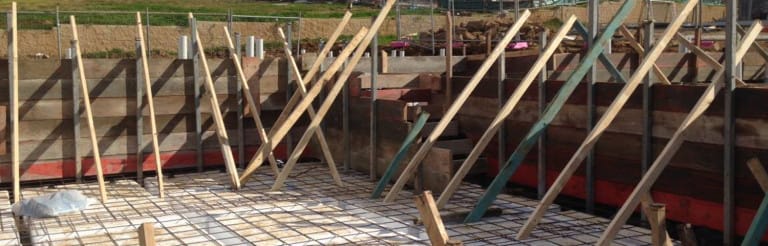
Forms are checked and confirmed. The edge forms that define the slab shape, thickness and level are installed and checked the day before the pour. Any adjustments to level, falls or penetration positions are made while there is still time to fix them without delaying the pour.
Reinforcement is placed. Steel mesh or bar is placed on plastic bar chairs at the correct cover depth above the sub-base. The bar chairs hold the steel at the right height in the concrete so it ends up with the correct cover as specified by the engineer.
Concrete is ordered. The concrete is ordered from the ready-mix plant for a specific delivery time. The mix design — strength grade, slump (workability), aggregate size and any admixtures — is confirmed with the plant. On Sydney residential jobs, most driveways and slabs are specified at 25 MPa or 32 MPa with a standard slump. House slabs are typically specified to AS 2870 requirements and may require a specific aggregate size for the reinforcement cover.
Access is confirmed. The concrete truck route to the site is confirmed. If a concrete pump is being used, the pump is booked and the pump truck access route and setup position are confirmed. If the truck can chute directly, the path from the truck position to the pour is checked for any obstacles.
Site Arrival and Setup
On the morning of the pour, the crew arrives before the first concrete truck. The first 30 minutes are setup and final checks.
Forms are checked for any movement overnight — particularly on a windy night or where heavy vehicles have passed nearby. Any stakes that have shifted are re-driven and re-checked for level.
The pump truck (where being used) is set up in position and the boom is rigged out to reach the pour area. The pump operator primes the system with a cement slurry to lubricate the pipeline before concrete arrives.
Site hazards are identified — overhead power lines, excavation edges, unstable ground around the pour area — and the crew is briefed on the pour sequence. On a large or complex pour, the sequence — where the concrete will go first, which direction the pour will progress, and where the finishing crew will work — is confirmed before the first truck arrives.
Reinforcement and Form Check
Before the concrete truck arrives, the reinforcement and forms get a final check. This is the last opportunity to identify and fix any issues before the concrete goes in — once the pour starts, there is no going back.
Form check. Every edge form is walked. Levels are rechecked at critical points — at falls changes, at penetration formers, at the junction between new and existing concrete. Any form that has moved is reset.
Reinforcement check. The mesh or bar is checked for position, cover and laps. Bar chairs are checked to confirm the steel is at the correct height. Any mesh that has been walked on and bent down is lifted back to the correct level. Penetration formers are checked for position against the drawings.
On residential jobs with a council or private certifier requirement for a reinforcement inspection, this is when the certifier comes on site. The pour does not start until the certifier has signed off. We schedule and coordinate this inspection as part of the programme.
Concrete Ordering and Delivery
Ready-mix concrete is produced at a batching plant and delivered to site in an agitator truck — the rotating barrel that keeps the concrete moving to prevent it from setting before it reaches the pour.
The mix design is confirmed with the plant when the concrete is ordered. The delivery is programmed for a specific time, and subsequent trucks are ordered to arrive at intervals that match the pour rate — typically 15 to 20 minutes between trucks on a residential job. Too long between trucks and the concrete already placed starts to stiffen before the next load arrives. Too short and trucks are queued on the street waiting.
Each truck delivers a docket showing the batch time, the water content, the truck number, the mix design and the date. The docket is the concrete’s record of compliance — it is kept on site and filed as part of the job documentation.
On arrival, the concrete in the truck is checked. Slump is tested if required — a slump cone test confirms the concrete is at the specified workability level. Water is not added to the truck on site. Adding water increases slump but reduces the final strength of the concrete and voids the mix design.
Pumped vs Chuted Concrete
The concrete leaves the truck either through the chute at the back of the barrel or through a concrete pump.
Truck chute. Where the truck can get close enough to the pour area, the concrete chutes directly from the truck into the forms. This is the fastest and cheapest delivery method and is used where site access permits. The maximum practical reach of a truck chute is about 3 to 4 metres from the truck rear.
Concrete pump. Where the pour area is more than a chute-length from the truck access point — a rear-of-block driveway, a first-floor slab, a constrained residential site — a concrete pump is used. The pump truck has a telescoping boom that can reach up to 40 or 50 metres from the truck position. Concrete is pumped through a pipeline from the truck to the end of the boom, where it is directed into the forms by the pump operator. Pump hire adds to the job cost but is often the only practical way to place concrete on constrained Sydney residential sites.
Placing the Concrete
Concrete is placed in the forms progressively — starting at one end or corner of the pour and moving in a planned sequence. The crew directs the concrete from the truck chute or the pump hose into the forms, raking and spreading with shovels and concrete rakes to distribute it evenly.
Concrete is placed as close as possible to its final position — it should not be moved laterally by raking more than about 500mm. Moving concrete horizontally after placing causes the aggregate to segregate — the coarse stone moves to the bottom of the spread and the cement paste moves to the top, producing a weaker, more porous surface.
The pour team works ahead of the finishing crew. The placing crew gets the concrete into the forms and roughly levelled; the screeding crew follows behind to bring it to final level.
Vibrating and Consolidating
Freshly placed concrete contains entrapped air voids. These voids reduce the concrete’s strength and increase its permeability. Vibration removes them.
An internal vibrator — a vibrating probe attached to a flexible shaft — is inserted into the concrete at regular intervals across the pour. The vibration causes the concrete to liquefy temporarily around the probe, allowing air bubbles to rise and escape from the surface. The vibrator is inserted vertically and withdrawn slowly — rapid withdrawal leaves a void in the concrete where the probe was.
On slabs, the vibrator is typically inserted every 300 to 400mm across the pour — closer to edges and around penetrations where air tends to accumulate. It is not used to move concrete laterally — only to consolidate it where it has already been placed.
Screeding and Levelling
Once the concrete is placed and vibrated, the surface is struck off to the correct level using a screed — typically a long straightedge struck along the tops of the edge forms in a sawing motion.
On flat slabs, the screed is pulled across the surface in overlapping passes to bring the concrete to a consistent level with the top of the forms. On slabs with drainage falls, the screed follows the designed fall.
After the initial screed, a bull float or darby is used to close any voids left by the screed and to flatten the surface before the finishing crew works it. The bull float also embeds the coarse aggregate slightly below the surface in preparation for the final finish.
Surface Finishing
The surface finish is applied after the concrete has started to stiffen slightly — when it has stiffened enough to hold a footprint but is still workable at the surface. The timing of this stage is critical and is one of the key skills of an experienced concreter. Too early and the finish tears the surface. Too late and the concrete has hardened beyond the point where it can be worked.
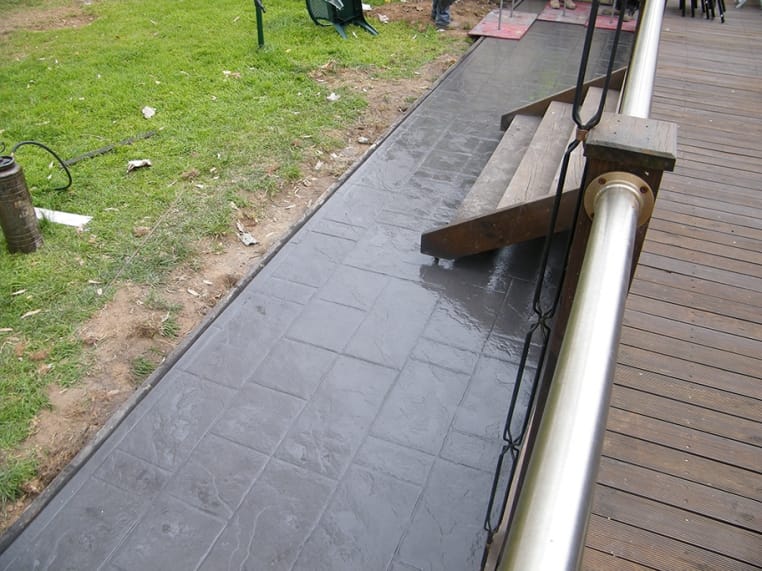
Broom finish (brushed). The most common finish for driveways and paths in Greater Sydney. A stiff bristle broom is dragged across the surface to create a textured, non-slip finish. The direction of the broom marks — across the driveway or along it — is specified before the pour.
Power float (smooth). Used for warehouse floors, garage floors and interior slabs where a flat, smooth surface is required. A ride-on or hand-held power float with rotating steel blades is used to work the surface progressively finer as the concrete stiffens.
Exposed aggregate. The surface is seeded with decorative aggregate and then washed with a retarder-treated water spray at the right time to reveal the aggregate. Timing the wash is the most skill-dependent part of the process — too early and the aggregate washes out completely, too late and the surface cannot be washed back.
For more on driveway finishes, see our guide to exposed aggregate driveways Sydney and our concrete driveways Sydney service page.
Ready to get your concrete poured? KMA Concrete Constructions — own crew, NSW Lic. 219967C, based in Penrith. Call 02 9054 3040 or get a quote online.
After the Pour — Curing and Protection
Curing is the process of maintaining the moisture and temperature conditions in the concrete that allow it to gain strength correctly. Concrete does not dry to gain strength — it gains strength through a chemical reaction (hydration) that requires water. If the concrete dries out too quickly, the hydration stops before the concrete reaches design strength.
On a hot, dry or windy Sydney day, freshly poured concrete can lose moisture from the surface very rapidly — causing surface crazing (a network of fine surface cracks) and reduced surface strength.
Curing on residential jobs in Greater Sydney typically involves:
Polythene sheeting. Plastic sheeting is placed over the finished surface as soon as the finishing is complete. This traps moisture against the surface and prevents rapid evaporation. The sheeting is left in place for a minimum of three days on most residential jobs.
Curing compound. A spray-applied membrane that seals the surface and retards evaporation. Used where sheeting is not practical — on vertical surfaces, on large commercial pours, or where the surface texture would be damaged by contact with sheeting.
Wet hessian. Hessian fabric kept wet and laid over the surface — an older method but still effective where sheeting is not suitable.
The site is protected from foot traffic for a minimum of 24 hours after the pour — longer in cold weather.
When Can You Use the Concrete?
Concrete gains strength progressively after the pour. For most residential applications:
| Use | Minimum wait |
|---|---|
| Foot traffic | 24 to 48 hours after pour |
| Light vehicle traffic (car) | 7 days |
| Heavy vehicle traffic (truck) | 28 days |
| Full design strength | 28 days |
These are minimum timeframes under normal Sydney conditions — warm weather accelerates strength gain, cold weather slows it. We advise on the appropriate wait time as part of the job handover, based on the mix design and the weather conditions during curing.
Frequently Asked Questions
Do I need to be home during the pour?
No — but you need to have site access sorted beforehand. Gate codes, unlocked access, parking cleared for the truck and pump — all of this needs to be sorted before the morning of the pour. We confirm all access details the day before.
How long does a residential concrete pour take?
A standard residential driveway — 40 to 80 square metres — takes four to six hours from crew arrival to finishing complete. House slabs take longer depending on the floor area. We give you an estimated completion time when we confirm the pour date.
What weather conditions affect a pour?
Extreme heat (over 35°C), high wind, rain and frost all affect the pour. We monitor the forecast in the days before the pour and advise if conditions are likely to require rescheduling. We do not pour in rain — water on freshly placed concrete dilutes the cement paste at the surface and reduces surface strength permanently.
Can I add water to the concrete on site?
No. Adding water on site increases workability but reduces the final strength of the concrete and voids the mix design. If the concrete is too stiff on delivery, the issue is resolved with the plant — not by adding water at the truck.
What if the concrete cracks after it is poured?
Fine hairline shrinkage cracks are normal and expected in most concrete slabs — they occur as the concrete shrinks slightly during curing and are typically cosmetic only. Control joints are cut into driveways and slabs within 24 hours of the pour to direct where shrinkage cracking occurs. Structural cracking — wide, moving, or vertically displaced cracks — is a different matter and requires assessment. See our guide to concrete resurfacing and repair.
Licensed Sydney concreters pouring residential, commercial and council concrete since 1999. Every job is worked to engineer-certified specifications by our own crew.
NSW Fair Trading Lic. 219967c · ABN 13 160 436 902 · Fully insured