On this page
- Five Things That Change on a Sloped Driveway
- Which Finish Is Correct on a Sloped Driveway?
- Drainage: The Component Most Homeowners Do Not Expect
- What to Ask Before Accepting a Sloped Driveway Quote
- Sealing Sloped Driveways: One Critical Difference
- Talk to KMA About Your Sloped Site
- Frequently Asked Questions
A concrete driveway on a slope costs more than a flat-site installation and requires a different specification in several ways that matter for safety, drainage and longevity. The gradient affects the concrete mix, the formwork setup, the drainage requirements and the surface finish.
A sloped site carries a cost premium over a flat-site installation at the same finish level. The steeper the gradient, the higher the premium, driven by the specialised concrete mix, extended formwork setup, drainage requirements and in many cases additional excavation scope. For a quote based on your specific site and gradient, call 02 9054 3040 or request a quote online.
KMA Concrete Constructions has been pouring sloped driveways across the Hills District, Penrith, the escarpment suburbs and throughout western Sydney since 1999. NSW Lic. 219967c. Own crew on every job.
Five Things That Change on a Sloped Driveway
1. The concrete mix must be stiffer.
Standard concrete mixes have enough workability to flow under gravity. On a slope, this means the mix slides downhill during the pour, producing a slab that is thinner at the top end and has pooled excess material at the bottom. The result is an uneven slab with variable thickness that does not meet the specification across its full area.
Sloped driveways require a low-slump mix: stiffer and less workable, holding its position on the gradient while the crew places and finishes it. Low-slump placement takes longer, is harder to work and requires an experienced crew who knows how the mix behaves differently on a gradient compared to a flat pour. This is a genuine labour cost that does not appear on a quote showing only a per-m² rate.
2. Formwork takes longer to build correctly.
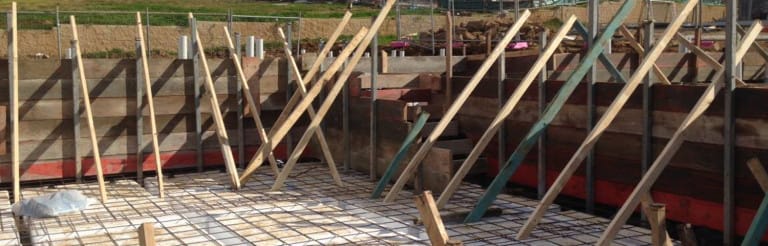
On a flat site, edge formwork is standard timber boards set in a few hours. On a slope, the formwork must physically hold the low-slump mix against gravity during placement, screeding and finishing. Getting this wrong means the slab shifts during the pour before it sets. Correctly built formwork on a sloped site takes more time and requires more robust bracing than a flat-site equivalent.
3. Drainage is a mandatory scope item, not an option.
Water running down a sloped driveway accelerates as it descends. By the time it reaches the base of the driveway, it arrives with velocity and volume. Without drainage infrastructure directing that water into the stormwater system, it sheets across the footpath and road, which creates a public slip liability and violates most Sydney council stormwater requirements.
A transverse drainage channel at the base of the driveway, connected to a stormwater pit or kerb outlet, is the standard solution. On longer or steeper driveways, a mid-slope channel prevents water from building excessive velocity across the full length. This is not an optional upgrade. It is a required scope item on any sloped driveway in Sydney.
4. Excavation scope increases with gradient.
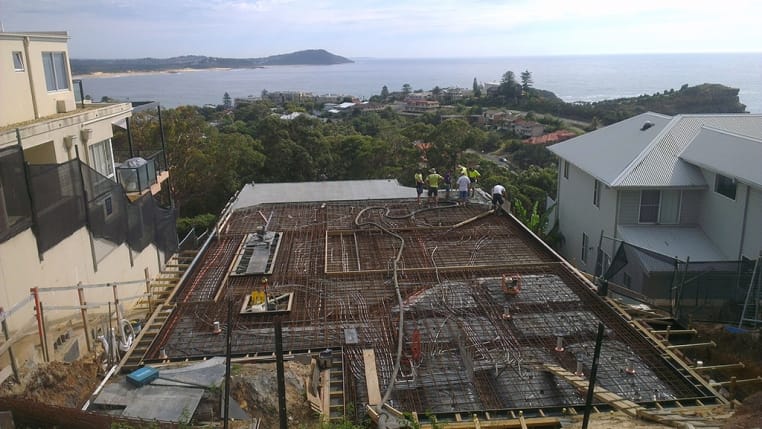
Establishing a stable, correctly graded sub-base on a sloped site requires cut and fill earthworks before the concrete can be poured. The extent of excavation depends on how steep the gradient is and whether the driveway follows the natural fall of the block or is engineered to reduce the effective gradient. On steep blocks, earthworks can be a significant scope item in their own right.
5. The finishing window is narrower than on a flat site.
On a sloped pour the crew works against gravity. The low-slump mix behaves differently under finishing tools than a standard pour and sets at a different rate depending on sun exposure and gradient. The timing window for exposed aggregate wash-off is narrower on a sloped site than a flat one. Miss it and the surface cannot be opened. Experienced crews who have poured hundreds of sloped driveways across western Sydney know the timing. Inexperienced crews produce uneven surfaces or miss the exposed aggregate window entirely.
Which Finish Is Correct on a Sloped Driveway?
Exposed aggregate is the correct specification for any sloped Sydney driveway above approximately 5 degrees. This is a safety and performance specification, not a preference.
Tyres apply shear force to the driveway surface on every departure and every arrival on a gradient. Under this repeated shear load, a plain broom finish wears progressively smoother over time. The broom texture is shallow from the outset and becomes shallower with sustained vehicle use on a slope. KMA has resurfaced sloped driveways across the Hills District and escarpment suburbs where the original broom finish had worn to near-smooth within 10 years of daily use. The slab structure was fine. The surface grip had gone.
Exposed aggregate holds its texture because the grip lives in the stone itself, not in a brushed cement surface that can wear back. The protruding aggregate creates a multi-directional, naturally rough profile that maintains genuine traction underfoot and under tyre in wet conditions. This is a structural property of the finish, not a coating applied on top, and it does not diminish under the shear loads of daily vehicle use on a gradient.
KMA’s dedicated guide to exposed aggregate driveways in Sydney covers the full process, stone colour options and long-term performance data for this finish.
Plain broom finish on a gentle slope (under 5 degrees) is acceptable provided the surface is resealed on schedule with a product containing an anti-slip additive. Above 5 degrees, exposed aggregate is the correct specification.
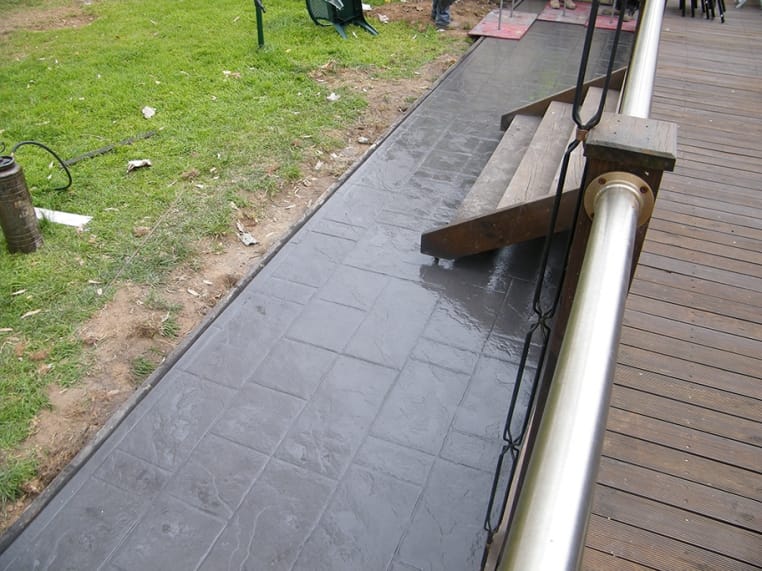
Coloured concrete performs identically to plain concrete for grip purposes. The pigment does not affect traction. A coloured concrete driveway with a broom finish is acceptable at gentle gradients. A smooth trowel finish over coloured concrete is not appropriate for any slope as it is slippery when wet and the gradient amplifies the risk.
Stamped concrete on a slope requires individual site assessment. The depth and profile of the stamped pattern determine how much grip it provides. Some patterns perform adequately on gentle slopes. On gradients above 10 degrees, exposed aggregate is a more reliable grip specification.
Drainage: The Component Most Homeowners Do Not Expect
Drainage is the most commonly underestimated component of a sloped driveway project and the one that produces the most expensive surprises after the job is done.
Water running down a 1-in-5 gradient driveway arrives at the base with significant volume and velocity. Without drainage, it sheets across the footpath and road, which:
- Creates a public slip liability at the base of the driveway
- Violates most Sydney council stormwater requirements
- Can result in a council remediation order requiring drainage installation at your cost after the driveway is already complete
The standard solution is a transverse drainage channel at the base of the driveway connected to a stormwater pit or kerb outlet. On longer driveways or steeper gradients, a mid-slope channel prevents water from building excessive momentum across the full gradient length.
KMA scopes drainage requirements as part of every sloped driveway assessment before quoting. A quote that does not address drainage on a sloped site is an incomplete quote.
What to Ask Before Accepting a Sloped Driveway Quote
A sloped driveway quote that does not address the following five points in writing is incomplete. Get answers to each before signing.
What concrete mix design will be used? Confirm it is a low-slump mix specified for the gradient, not a standard mix. If the concreter does not know what slump is, that is your answer.
What reinforcement is specified and where will it be positioned? SL72 is the minimum for standard residential. SL82 is more appropriate on steep gradients. Mesh must be positioned in the middle third of the slab depth to provide tensile benefit.
How is drainage addressed? What infrastructure is included in the scope? Where does the surface water discharge? Is a stormwater connection required?
What surface finish is specified and why is it appropriate for this gradient? If broom finish is specified on a driveway above 5 degrees, ask for a written justification. If none is provided, that is a risk signal.
Has the site been assessed for its soil classification and sub-base requirements? On reactive clay under a sloped driveway, seasonal soil movement has a directional downslope component that increases sub-base specification requirements above what a flat-site standard requires.
KMA provides written specifications addressing all of the above on every sloped driveway quote.
Sealing Sloped Driveways: One Critical Difference
Sealing requirements are identical to flat driveways in terms of timing (28 days from pour), frequency and product type. There is one critical addition specific to sloped driveways.
The sealer must not reduce grip. High-gloss wet-look topical sealers can reduce surface friction on steep gradients when the surface is wet and hot. On any sloped driveway, specify either a penetrating sealer or a low-sheen topical product with an anti-slip additive confirmed in the product technical datasheet. Do not apply a high-gloss acrylic to an exposed aggregate driveway on a gradient without confirming anti-slip performance.
The concrete driveway sealing guide covers sealer types, application timing and reseal frequency for each finish type in detail.
Talk to KMA About Your Sloped Site
Sloped driveways are a regular part of KMA’s work across the Hills District, Penrith, the escarpment suburbs and Campbelltown. They are not a complication we work around. They are a known scope category with specific requirements that KMA has been specifying and delivering correctly across western Sydney since 1999.
NSW Lic. 219967c. Own crew on every job, no subcontractors.
Call 02 9054 3040 with your site dimensions and gradient. Or request a quote online. View all KMA driveway services.
Frequently Asked Questions
Does a concrete driveway on a slope cost more?
Yes. A sloped site carries a cost premium over a flat-site installation at the same finish level. The steeper the gradient, the higher the premium. The low-slump concrete mix, extended formwork setup, drainage channels and additional excavation all contribute. Call 02 9054 3040 for a quote based on your specific site.
What is the best finish for a sloped concrete driveway?
Exposed aggregate. The natural stone surface maintains grip under tyre loads in wet conditions and does not wear smooth over time the way a broom finish does under sustained shear loading from vehicles on a gradient.
Why does a sloped driveway need a different concrete mix?
Standard mixes flow downhill during a pour on a gradient, producing an uneven slab thinner at the top and pooled at the bottom. A low-slump (stiffer) mix holds its position on the slope during placement and finishing, producing a slab with consistent thickness and surface quality across the full gradient.
Does a sloped driveway need drainage channels?
On any driveway above a slight gradient, yes. Water accelerating down the slope must be directed into a stormwater system. Most Sydney councils require a transverse channel at the base connected to a pit or kerb outlet. KMA assesses and scopes drainage as part of every sloped driveway quote.
Is there a maximum gradient for a concrete driveway in Sydney?
Requirements vary by council. Practically, driveways above 1-in-5 (20 per cent) become difficult for standard passenger vehicles in wet conditions. Above 1-in-4 (25 per cent) requires engineering consideration. KMA assesses each sloped site individually.
Can I resurface a sloped driveway?
Yes, provided the existing slab is structurally sound. Drainage and grip requirements apply equally to resurfaced driveways as to new ones. An exposed aggregate overlay on a structurally sound sloped slab is a viable path. See the concrete resurfacing and repair page for what resurfacing can and cannot deliver.
Last updated
Licensed Sydney concreters pouring residential, commercial and council concrete since 1999. Every job is worked to engineer-certified specifications by our own crew.
NSW Fair Trading Lic. 219967c · ABN 13 160 436 902 · Fully insured