On this page
- Quick Summary
- What Makes a Commercial or Industrial Slab Different
- The Penrith and Western Sydney Industrial Context
- Mix Strength: Why N32 Is Not Always Enough
- Joint Design for Industrial Slabs
- Surface Finish for Commercial and Industrial Applications
- Drainage on Hardstand and Wash Bay Pours
- What to Confirm Before Any Commercial or Industrial Pour
- Frequently Asked Questions
Quick Summary
A commercial concrete floor inside a building is one scope. A concrete hardstand, loading dock, or outdoor industrial slab is a completely different one. The mix is stronger, the thickness is greater, the joint spacing is wider, and the consequences of getting it wrong are measured in load-bearing failures and forklift incidents rather than cracked driveways. Most problems KMA sees on commercial pours in Sydney trace back to one source: the specification was written for a residential job and applied to a commercial one.
A commercial concrete floor inside a building is one scope. A concrete hardstand, loading dock, or outdoor industrial slab is a completely different one. The mix is stronger, the thickness is greater, the joint spacing is wider, the drainage specification is more complex, and the consequences of getting it wrong are measured in load-bearing failures and forklift incidents rather than cracked driveways.
Most of the problems KMA sees on commercial and industrial concrete pours in greater Sydney trace back to one source: the specification was written for a residential job and applied to a commercial one. This guide covers what separates an industrial slab from a residential one, what a correct commercial specification looks like, and the questions to ask before the concrete is ordered.
Call KMA on 02 9054 3040 or request a quote online to discuss your commercial or industrial concrete scope.
What Makes a Commercial or Industrial Slab Different
The differences are not cosmetic. They run through every element of the specification.
| Specification Element | Residential Driveway | Industrial / Commercial Hardstand |
|---|---|---|
| Concrete strength | N25 minimum | N32 to N50 depending on load |
| Slab thickness | 100mm typical | 150mm to 300mm depending on use |
| Reinforcement | SL72 mesh | Engineered reinforcement to structural drawings |
| Joint spacing | 3m to 4m | Designed to load distribution and traffic pattern |
| Surface finish | Broom, aggregate | Power float, hardener, or industrial sealer |
| Drainage | Surface fall to edge | Engineered drainage with industrial grates |
| Sub-base | Compacted road base | Specified fill, compaction tested |
A concrete hardstand carrying fully loaded semi-trailers needs a fundamentally different specification to a concrete driveway carrying passenger vehicles. The physics of load transfer, the joint spacing required to manage thermal movement under repeated heavy load, and the surface finish required to handle forklift tyres without surface breakdown are all distinct design decisions.
The Penrith and Western Sydney Industrial Context
KMA has been pouring concrete across the Penrith corridor since 1999. The Western Sydney logistics and industrial market has grown significantly across Erskine Park, Kemps Creek, Mamre Road, and the broader Penrith Industrial Estate. Hardstand areas, loading docks, wash bays, container storage pads, and heavy vehicle manoeuvring areas are standard scope across this market.
The ground conditions in the western Sydney industrial belt vary significantly. Reactive clay soils in some areas require engineered sub-base preparation. Sites on the Bringelly Shale formation require specific compaction protocols before any slab is poured. Getting this wrong means pouring a 200mm industrial slab on a sub-base that was not compacted to the required standard, which produces a slab that cracks under load regardless of what is on top.
A pre-pour sub-base assessment is standard on commercial and industrial work. It is not optional.
Mix Strength: Why N32 Is Not Always Enough
Concrete mix strength for industrial and commercial applications is not a single number. It is a function of the load the slab will carry, the frequency of that load, and the exposure conditions the surface will face.
N32 concrete is standard for light commercial applications: pedestrian plazas, retail forecourts, light vehicle hardstands. N40 is appropriate for regular forklift traffic, heavy vehicle access, and loading dock aprons. N50 is used for high-frequency heavy load applications: container storage yards, heavy manufacturing floors, and applications where point loads from racking or plant equipment are significant.
Using N32 where N40 is the correct specification does not produce a slab that fails on day one. It produces a slab that fails at year four instead of year twenty, under loads it was never specified to carry.
Joint Design for Industrial Slabs
Control joints on a residential driveway are cut at 3 to 4 metre intervals in a grid pattern. On an industrial slab, joint design is an engineering decision determined by the load distribution pattern, the traffic flow, the slab thickness, and the thermal movement expected at the site.
Joints in the wrong position on a forklift floor are a safety and operational issue. A joint that falls in the path of a forklift travelling loaded produces edge spalling and joint breakdown under repeated impact. A correctly designed joint is in a position where it does not face that repeated dynamic load.
Industrial joint design is done from a drawing, not estimated on site. Any contractor quoting an industrial slab without reference to a joint layout drawing is guessing.
Surface Finish for Commercial and Industrial Applications
Broom finish is not appropriate for most commercial and industrial concrete. The standard finishes for these applications are:
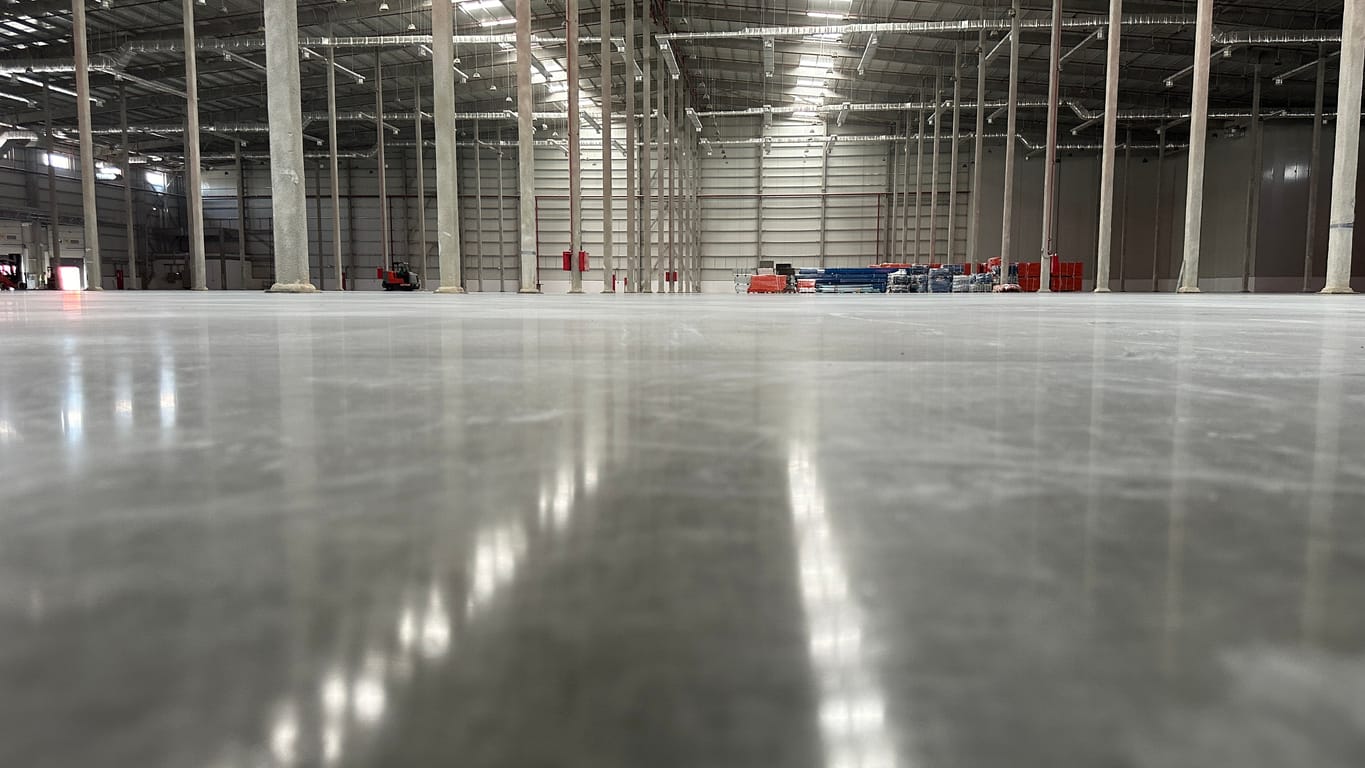
Power float finish. A mechanically trowelled surface that is dense, hard, and flat to within tolerances required for racking systems and forklift operation. A racking installation in a warehouse has specific flatness requirements. The floor specification must reflect them.
Dry shake hardener. A surface-applied hardener broadcast and trowelled into the fresh concrete surface. Significantly increases surface hardness and abrasion resistance. Standard on floors subject to regular forklift traffic, heavy trolley movement, or steel-wheeled industrial equipment.
Epoxy or polyurethane coating. Applied after curing on floors requiring chemical resistance, dust suppression, or a cleanable surface. Common in food processing, pharmaceutical, and wash bay applications.
A broom finish on an industrial concrete floor is a floor that will show surface breakdown within two to three years of regular forklift traffic.
Drainage on Hardstand and Wash Bay Pours
Commercial and industrial concrete must be graded to drain. Standing water on a hardstand corrodes the surface, creates slip risk, and in a wash bay application means compliance failure.
Drainage falls for a concrete hardstand are designed to collect at an outlet, not to sheet across an open site. Industrial drainage grates are specified to carry the load of the vehicles that will cross them. A residential-grade drainage channel in the path of a loaded semi-trailer is a failure waiting to happen.
Wash bay concrete requires specific drainage to trade waste compliance requirements in NSW. The surface must fall consistently to a trapped drain. The concrete mix must resist the chemicals used in the washing process. The slab perimeter must contain spills.
What to Confirm Before Any Commercial or Industrial Pour
- Has a sub-base compaction test been specified before the pour?
- Is the mix strength specified in MPa against the operational load, not a residential default?
- Is the slab thickness calculated from a structural drawing or estimated on site?
- Is joint design on a drawing or decided during the pour?
- Is the surface finish specified for the operational use?
- Is drainage designed to an engineering specification?
- Does the contractor carry the appropriate insurance for commercial work?
Frequently Asked Questions
Do I need council approval for a commercial hardstand pour?
Depending on the extent of the works and the zoning, development consent may be required. A hardstand that increases impervious surface area may trigger stormwater management requirements under the local council LEP. Confirm with the relevant council before pouring.
How long does a correctly specified industrial concrete slab last?
A commercial hardstand specified to the correct strength, thickness, and joint design should give 20 to 30 years of serviceable life under the loads it was designed for. Surface treatments extend that where abrasion is the primary wear mechanism.
What is the minimum slab thickness for forklift traffic?
A standard counterbalance forklift with a 2-tonne capacity running on a hardstand typically requires a minimum 150mm slab at N32 or stronger, with appropriate sub-base. Heavier forklifts require thicker specification. Always confirm against the forklift manufacturer’s ground bearing pressure specification.
Can a residential concreter pour an industrial slab?
Technically yes, but the specification, joint design, and surface finishing requirements for an industrial slab are different from residential work. An experienced residential concreter who has not poured to an industrial specification will produce a residential-quality result on an industrial-load application.
—
KMA Concrete Constructions has been pouring commercial and industrial concrete across greater Sydney and the Penrith corridor since 1999. We pour to specification, not to estimate. Our own crew on every commercial job. No subcontractors.
Call 02 9054 3040 or request a quote online.
View all services | Concrete driveways Sydney | Concrete resurfacing and repair Sydney
Licensed Sydney concreters pouring residential, commercial and council concrete since 1999. Every job is worked to engineer-certified specifications by our own crew.
NSW Fair Trading Lic. 219967c · ABN 13 160 436 902 · Fully insured