On this page
- Why would a concrete job need a pump?
- What is the difference between a concrete boom pump and a line pump?
- How does site access decide the method?
- What changes about the concrete mix when pumping?
- How much concrete is lost in a pump?
- Does pumping affect how the slab is finished?
- Who arranges the pump?
- Is pumped concrete more expensive?
- Frequently asked questions
Most concrete arrives in a truck and travels down a chute. On a site where the truck cannot get near the pour, it arrives through a pump instead. Whether you need one depends on distance, height and access, and the decision is usually made before the day of the pour rather than on it.
At a glance
- A pump moves concrete from the truck to a pour position the chute cannot reach
- Boom pumps reach over obstacles. Line pumps run pipe to the position
- Reach and access determine the choice, not volume
- Pumped concrete needs a slightly different mix to flow correctly
- Pump time and setup are priced separately from the concrete
Why would a concrete job need a pump?
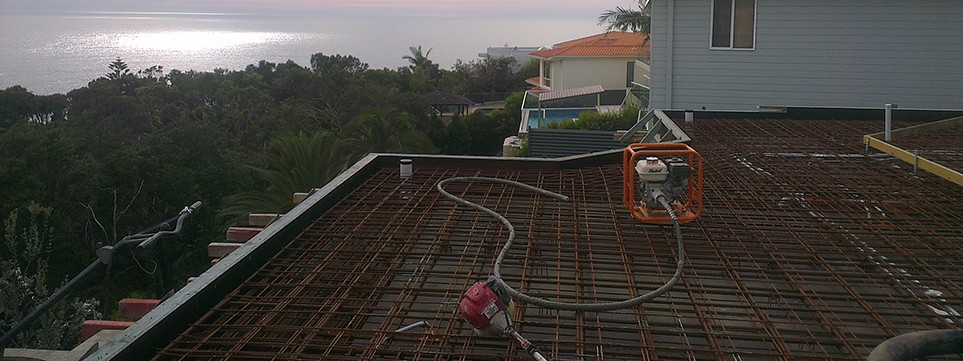
Any job where the truck cannot reverse or position within chute reach of the pour. That covers rear yards behind an occupied house, tight side access, elevated slabs, multi-level sites, and large areas where dragging the pour across the slab would take hours and create cold joints.
Boundary setbacks on newer subdivisions are a frequent cause. A house with a narrow side access and a pool in the backyard simply has no path for a truck.
What is the difference between a concrete boom pump and a line pump?
A concrete boom pump carries an articulated boom that unfolds and reaches over obstacles to place concrete directly at the pour. It is fast, needs less site preparation and can place a large volume quickly. It also needs a suitable position for the truck to set up and enough clearance to unfold the boom.
A line pump pushes concrete through steel pipe laid from the truck to the pour position. It is slower to set up because the line has to be run, but it can reach places a boom cannot, such as through a narrow side access and around the back of a building.
The choice is dictated by what is physically possible on the site rather than by preference.
How does site access decide the method?
Work outward from the pour position. How far from the nearest possible truck position is it. What is in between. Is there a clear path wide enough for a line with no tight bends. And is there space at the truck position for a boom to set up and unfold safely.
A job that looks straightforward can turn on one detail, such as an overhead power line across the only boom setup position, or a driveway that will not take the weight of a loaded truck.
What changes about the concrete mix when pumping?
Pumped concrete has to flow through a pipe without segregating, so the mix is adjusted rather than used as standard. That usually means a slightly higher slump and a well-graded aggregate, designed for pumpability rather than simply for strength.
This is why the pump operator and the concrete supplier need to be talking before the day. A mix designed for a chute pour can block a line, and a blocked line on a residential pour means a delay while it is cleared and a risk to the finish.
How much concrete is lost in a pump?
A quantity of concrete remains in the boom or line and is flushed out at the end. That concrete is bought and not placed, so a pumped job carries wastage a direct pour would not. This is a real cost that belongs in the quantity calculation, not a rounding error.
Our guide to how much concrete a slab needs covers how the order should be built, including pump losses.
Does pumping affect how the slab is finished?
It can. Concrete placed through a pump is typically wetter than a chute-placed load, so finishing timing shifts and the surface may need more attention. On a decorative finish, that matters, because the window between placing and finishing is tighter.
Our post on what happens during a concrete pour covers the sequence from setup to finishing, and where the pump fits in it.
Who arranges the pump?
Either the concreter or the client, depending on the arrangement. What matters is that someone does, that it is booked for the right day, and that the cost is either in the quote or explicitly excluded.
If a quote does not mention pumping and the site clearly needs it, that is the first question to ask. Our post on concrete driveways on a slope covers the access problems that often lead to a pump being required.
Is pumped concrete more expensive?
The concrete itself is priced as concrete, and pumping is a separate charge for the equipment and operator. Whether it is worth it depends on the alternative, which is either more labour moving concrete by wheelbarrow or a slower pour with a greater risk of cold joints.
On most tight-access Sydney jobs, pumping is the cheaper option once labour is counted honestly.
Frequently asked questions
How far can a concrete pump reach?
Boom reach varies considerably with the machine, and line pumps reach as far as the pipe can be run. Both are set by the equipment on the day rather than by a general rule.
Can a pump reach over a house?
A boom can reach over some obstacles depending on its size and setup position. Overhead power lines and clearance set hard limits.
Is a pump always needed for a backyard slab?
Not always. If a truck can reach within chute distance, no. The test is reach, not simply that the slab is at the back.
Can you pump small quantities?
Yes, though the fixed cost of mobilising a pump weighs more heavily on a small pour.
Does pumping damage lawns or driveways?
The equipment is heavy, so setup positions need thought and protection. Some sites need ground protection before the truck arrives.
What happens if the pump blocks?
The pour stops while it is cleared. It is the main operational risk of pumping and the reason the mix design matters.
Pour position a problem on your site? Request a quote or call 02 9054 3040. Our driveway page covers access-heavy residential work, and our commercial flooring page covers larger pours.
Licensed Sydney concreters pouring residential, commercial and council concrete since 1999. Every job is worked to engineer-certified specifications by our own crew.
NSW Fair Trading Lic. 219967c · ABN 13 160 436 902 · Fully insured