On this page
- What does a concrete expansion joint actually do?
- How is an expansion joint different from a control joint?
- Why do concrete expansion joints fail?
- What are the warning signs that a concrete expansion joint needs attention?
- Where do expansion joints need to go?
- Can a failed joint be repaired?
- Does sealing a slab protect the joints?
- How long should an expansion joint last?
- Frequently asked questions
A concrete expansion joint is the deliberate gap that lets two parts of a slab move without tearing each other apart. Most of the cracking homeowners complain about is not a concrete failure at all. It is a jointing failure, and the difference changes what the repair should be.
At a glance
- Expansion joints allow movement. Control joints direct where cracks occur
- Construction joints mark where one pour ended and the next began
- The three are often confused, and the confusion leads to the wrong repair
- A failed joint lets water in, which is when damage accelerates
- Joint condition is the first thing to check on any cracked slab
What does a concrete expansion joint actually do?
An expansion joint provides a physical separation between two concrete elements so that each can move without loading the other. The gap contains a compressible filler that takes up movement and keeps debris out.
The key point is that the joint is not there to prevent cracking. It is there to let movement happen in a controlled place rather than a random one.
How is an expansion joint different from a control joint?
A control joint, also called a contraction joint, is a deliberate line of weakness cut or formed into a slab so that shrinkage cracking happens along that line instead of across the surface. It permits the slab to crack neatly rather than randomly.
A construction joint is the interface between two separate pours. It is a cold joint in the structural sense and needs deliberate treatment, because concrete placed against already-cured concrete does not bond the same way.
A concrete expansion joint is the only one of the three designed for actual movement between elements. Treating a control joint as though it were an expansion joint, or the reverse, is how repairs get done twice.
Why do concrete expansion joints fail?
Filler degradation. The compressible filler breaks down over time, particularly when exposed to sun and water, and stops absorbing movement.
Loss of sealant. Once the sealant fails, water enters the joint and begins working on the concrete edges and on anything below.
Incompressible debris. Grit and gravel lodge in the gap and prevent it closing, which transfers load into the slab instead of being absorbed.
Inadequate size. A joint that is too narrow for the movement it has to accommodate has nowhere to go.
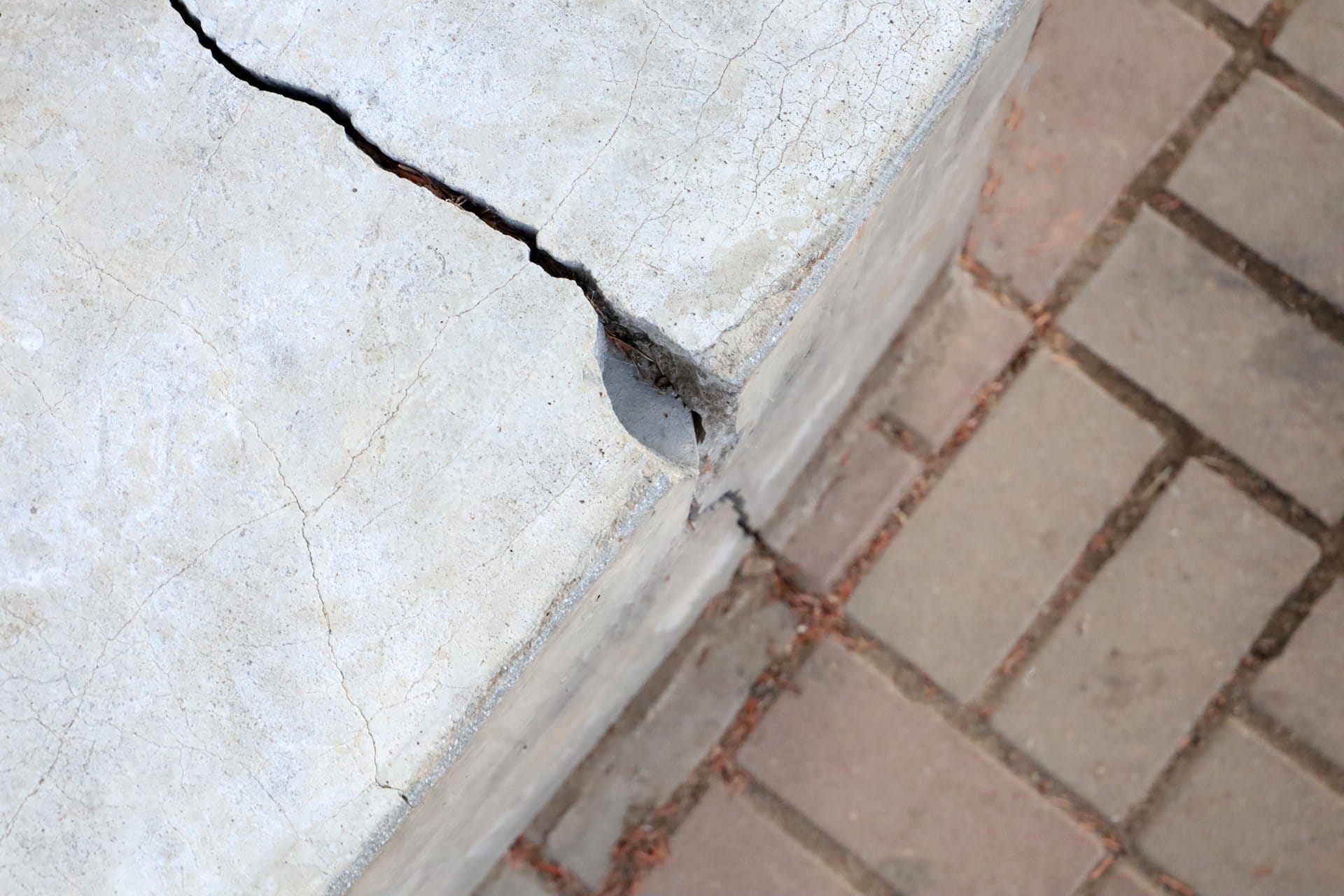
Missing joint. Two elements joined without a joint will crack at the point of highest stress, which is usually the internal corner.
What are the warning signs that a concrete expansion joint needs attention?
Uneven edges either side of the gap, a visible step between sections, sealant that has pulled away or cracked, weeds or soil in the gap, and water pooling along the joint line rather than draining away.
Any of these is worth addressing early. Water entering a joint is the mechanism that turns a maintenance item into a structural repair, because it reaches the sub-base and, on some construction, the reinforcement.
Our post on concrete cancer and spalling covers what happens when water reaches reinforcement and the concrete starts to break down from the inside.
Where do expansion joints need to go?
Between a slab and a fixed structure such as a house wall or a footing. Between separate slabs that may move independently. Around pool coping and pool structures. Where a new slab meets an existing one. Across a slab where the design calls for a movement joint rather than a control joint.
The specific positions come from the design. What matters for a homeowner is that they are present and visible, because a joint that was never installed cannot be maintained.
Can a failed joint be repaired?
Usually yes, and the repair is straightforward while the failure is contained to the joint. That means removing the failed filler and sealant, cleaning the gap properly, re-instating a backer rod at the correct depth and installing a fresh sealant rated for the movement expected.
This is a repair rather than a resurface. Our post on concrete resurfacing covers when resurfacing is the right answer and when the joint itself is the actual problem.
Does sealing a slab protect the joints?
It helps, because a sealed surface sheds water rather than letting it sit against the joint line. It is not a substitute for maintaining the joint itself, since the sealant in the joint is what does the work.
Our guide to sealing a concrete driveway covers sealer selection and resealing intervals, which is the maintenance side of the same problem.
How long should an expansion joint last?
It depends on exposure and on the material used. Joints in full sun and regularly wet areas degrade faster than sheltered ones, which is why a driveway joint facing north is the one that needs attention first.
There is no fixed service life. Inspecting joints at the same time you reseal the surface is the practical approach, because both are on the same maintenance cycle.
Frequently asked questions
Is a gap in my slab an expansion joint?
Possibly. A straight, filled gap that runs the full width is a deliberate joint. An irregular crack is not.
Why has my expansion joint filler come out?
Usually adhesive failure, either from installation onto a damp or dirty surface or from age. It can be replaced rather than worked around.
Does a concrete expansion joint need sealant?
It needs something to keep water and debris out, and a proper joint sealant performs both roles. Left open, debris fills the gap and the joint stops working.
Can I fill an expansion joint with mortar?
No. Mortar is rigid, so it transfers movement straight back into the slab and defeats the purpose of the joint.
Do all slabs need expansion joints?
Every slab needs jointing appropriate to its design. Not every joint is an expansion joint, and understanding which type you have determines how it should be maintained.
Should a concrete driveway have expansion joints?
Yes, at the interface with the house, at any crossing structure and where the design specifies them. Our post on concrete driveways versus pavers covers how the two systems handle movement differently.
Seeing joint problems on a slab? Request a quote or call 02 9054 3040. Our resurfacing and repair page covers remediation, and our post on how long a concrete driveway lasts sets out the factors that shorten it.
Licensed Sydney concreters pouring residential, commercial and council concrete since 1999. Every job is worked to engineer-certified specifications by our own crew.
NSW Fair Trading Lic. 219967c · ABN 13 160 436 902 · Fully insured