
On this page
- What Actually Drives the Price
- Concrete Driveway Cost by Finish Type
- What a Cheap Quote Is Actually Missing
- How Thick Does a Concrete Driveway Need to Be?
- How Long Before You Can Drive on a New Concrete Driveway?
- Single Driveway vs Double Driveway: What Changes?
- Does a Concrete Driveway Add Value to Your Property?
- Talk to KMA
- Frequently Asked Questions
The price of a concrete driveway in Sydney depends on more than the m² rate. Finish type, site conditions, slab specification, old driveway removal and council crossover requirements all affect the final number. A quote that shows only a per-m² rate and a total is hiding the detail you need to compare properly.
KMA Concrete Constructions has been pouring residential driveways across Sydney since 1999. NSW Lic. 219967c. Call 02 9054 3040 for a straight, itemised quote.
What Actually Drives the Price
Finish type. Plain broom is the most affordable starting point. Coloured concrete adds a premium. Exposed aggregate costs more again because the wash-off process, specialist timing and chemical retarder all add to the labour. See KMA’s concrete driveways Sydney service page for a full breakdown of each finish and what the installation process involves.
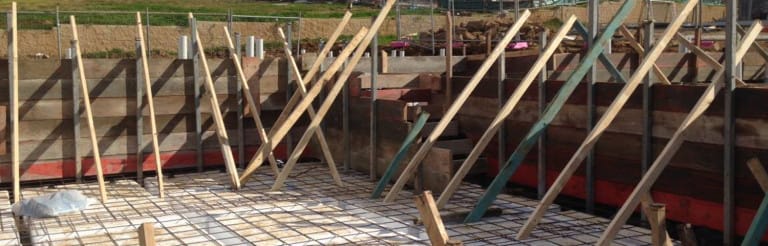
Slab thickness and mesh. Under AS 3727.1:2016, the minimum for a passenger car driveway is 100mm with SL72 steel mesh. Utes, vans, caravans and heavy SUVs warrant 125mm with SL82. Upgrading adds material and concrete volume to the price.
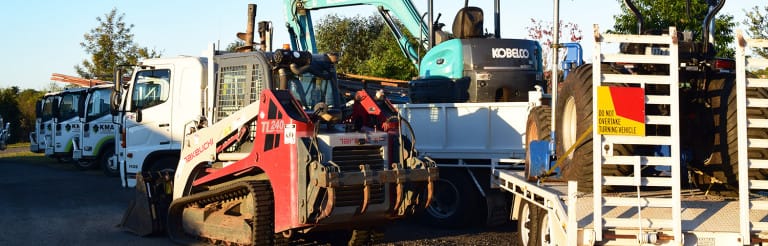
Site conditions and access. A flat, clear block with easy truck access is the cheapest scenario. A sloped site requires more excavation, drainage work and in some cases a concrete pump. Restricted access through a narrow side gate or rear-of-block position triggers pump truck hire. That is not an extra bolted onto the quote. It is the actual cost of your site.
Old driveway removal. Demolishing and disposing of an existing concrete slab adds cost before the new driveway begins. This must be itemised separately in any complete quote.
Council crossover (Section 138). The crossover from your property to the road requires a Section 138 permit under the Roads Act 1993. Fees vary across Sydney councils. KMA manages crossover applications across all Sydney metropolitan councils as part of every driveway quote.
Sub-base preparation. Most of western Sydney sits on Bringelly Shale, reactive clay classified
H1 or H2 under AS 2870. A correctly compacted 75 to 100mm road base sub-base is mandatory for a slab that lasts. Quotes that skip this step are cheaper on paper and fail within a few years on these soils. KMA has assessed failed driveways across Penrith, Blacktown and Campbelltown where the root cause is the same every time: no sub-base.
Concrete Driveway Cost by Finish Type
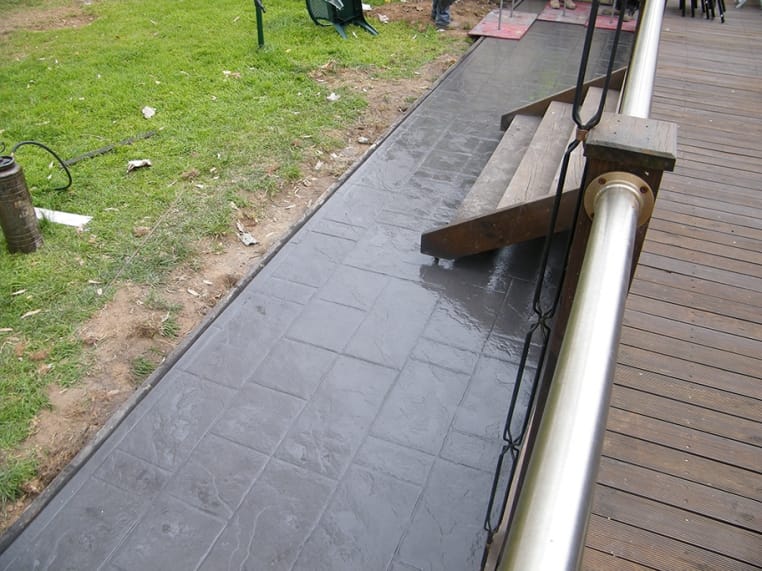
Finish type is one of the most significant variables in driveway pricing. As a general principle, plain broom finish is the most affordable, coloured concrete sits in the middle, and exposed aggregate carries the highest labour premium due to the specialist wash-off process and timing required.
Prices also vary significantly depending on whether the site is flat or sloped, how accessible the site is, and whether old driveway removal is required. For an accurate figure for your specific project, call 02 9054 3040 or request a quote online.
Inner Sydney typically runs higher than western Sydney for the same specification. A sloped site carries an additional premium over a flat-site installation at the same finish level.
For the full exposed aggregate breakdown, KMA’s guide to exposed aggregate driveways Sydney covers the process, stone colour options and what long-term performance looks like after ten, fifteen and twenty years of use.
What a Cheap Quote Is Actually Missing
The cheapest concrete driveway quote in Sydney is almost always missing something. These are the most common places corners get cut and why each one matters later.
Slab thickness. AS 3727.1:2016 sets 100mm as the minimum for vehicle loads. A 75mm pour fails the standard before a car parks on it. Once the job is done and the concrete has cured, you cannot tell the thickness from the surface.
Sub-base. Skipping or thinning the compacted road base removes the layer that stops reactive clay from cracking the slab from below. This is the single most common cause of premature driveway failure across western Sydney. Not bad concrete. Missing preparation.
Reinforcement grade. SL72 mesh correctly positioned in the middle third of the slab provides the tensile strength the slab needs. Lighter mesh, or mesh placed at the bottom of the pour, provides none. This is also not detectable from a finished, cured surface.
Control joints. Saw-cut control joints placed at the correct spacing guide where the slab cracks as it cures. Concrete always cracks during hydration as the slab shrinks slightly. Control joints direct that cracking into planned, concealed locations. Without them, the slab cracks wherever the internal stress finds the weakest path, which is usually across the most visible part of the driveway.
KMA quotes from a full written specification. Every item is listed. The price quoted is the price paid.
How Thick Does a Concrete Driveway Need to Be?
Slab thickness is set by AS 3727.1:2016, not by what the concreter wants to pour.
- 100mm with SL72 mesh: minimum for standard passenger cars
- 125mm with SL82 mesh: correct for utes, vans, SUVs and heavy trailers
- 150mm with SL92 mesh: appropriate for regular light commercial access
Concrete grade: N25 (25MPa) minimum for any vehicle driveway. N32 is the correct grade for heavy vehicles, steep sites or H2-rated reactive clay. KMA quotes the correct specification for your site, not the cheapest specification that wins the job.
How Long Before You Can Drive on a New Concrete Driveway?
AS 3727.1:2016 specifies a minimum of 7 days before vehicle traffic on a residential slab. Full design strength is reached at 28 days. For heavy vehicles including caravans, boats and trucks, the 28-day mark is the correct threshold.
Driving on a slab before 7 days risks permanent tyre impressions in the surface, particularly in warmer weather when the surface is still developing full hardness. On a freshly poured exposed aggregate driveway, early vehicle traffic can dislodge surface pebbles before the cement bond has fully cured. KMA confirms curing timelines at the quote stage so you can plan access around the project without surprises.
Single Driveway vs Double Driveway: What Changes?
Most Sydney properties have either a single-car driveway or a double-car driveway. The per-square-metre rate is similar regardless of size, but a few cost items do not scale with area.
Council crossover permits are a fixed fee regardless of driveway width. Old driveway demolition costs the same per m² whether it is a single or double. Concrete pump hire, if required, is also a fixed cost that does not change with driveway size.
This means the per-m² total price is slightly higher on a single-car driveway than on a double, because the fixed costs are spread across fewer square metres. A homeowner widening an existing single driveway to a double gets better per-m² value on the new section than on the original.
Does a Concrete Driveway Add Value to Your Property?
A professionally installed driveway improves kerb appeal and removes a potential negotiation point at sale. A cracked, uneven or unpermitted crossover consistently becomes a price reduction conversation with buyers. A worn or stained driveway signals deferred maintenance to buyers at first inspection, even when the house itself is immaculate.
KMA’s experience across Penrith, Parramatta, Blacktown and the Hills District is that a quality driveway is one of the few outdoor improvements buyers notice immediately and factor into their offer. An exposed aggregate driveway in particular reads as a considered, quality finish rather than the default option.
Conversely, a cheap driveway installed without a proper sub-base or the correct slab thickness can become a liability at sale if the buyer’s inspector identifies structural cracking or a sub-standard crossover. The cost of the cheap quote becomes visible at the worst possible time.
Talk to KMA
KMA Concrete Constructions. Pouring residential driveways across greater Sydney since 1999. NSW Lic. 219967c. Own crew on every job. Itemised quotes, no hidden costs.
Call 02 9054 3040 with your site dimensions and the finish you are considering. Or request a quote online. View all concreting services.
For how long your new driveway will last and what determines that, see the concrete driveway lifespan guide.
Frequently Asked Questions
How much does a concrete driveway cost in Sydney?
The price depends on finish type, site access, slab specification, old driveway removal and council crossover requirements. Plain broom finish on a flat site is the most affordable starting point. Exposed aggregate on a sloped site with restricted access sits at the higher end. Call 02 9054 3040 for an itemised quote based on your specific site.
What is included in a concrete driveway quote?
A complete quote itemises: excavation, sub-base preparation, formwork, reinforcement, concrete supply and pour, surface finish, saw-cut control joints and site clean-up. Council crossover permit fees and old driveway removal should be listed separately. If a quote shows only a per-m² rate and a total, ask for the itemised breakdown before accepting.
Why do concrete driveway quotes vary so much in Sydney?
The specification inside each quote varies. A quote that skips the sub-base, uses lighter mesh or pours a thinner slab will be cheaper on the day and fail within 5 to 10 years on Sydney’s reactive clay soils. Compare specifications side by side, not totals.
Do I need council approval for a concrete driveway in Sydney?
The driveway on your own land is generally exempt development. The crossover connecting your property to the road requires a Section 138 permit under the Roads Act 1993. KMA manages crossover applications as part of every new driveway quote.
Does a concrete driveway add value to my home?
A professionally installed driveway improves kerb appeal and removes a potential negotiation point at sale. KMA’s experience across Penrith, Parramatta and the Hills District is that a quality driveway is one of the few outdoor improvements buyers notice and factor in immediately.
How long does a new concrete driveway last?
A correctly specified and installed driveway lasts 25 to 40 years with basic sealing and maintenance. Driveways that fail before 10 years almost always have a specification problem: thin slab, poor sub-base or missing control joints. The concrete itself rarely fails early when the specification is correct.
Last updated
Licensed Sydney concreters pouring residential, commercial and council concrete since 1999. Every job is worked to engineer-certified specifications by our own crew.
NSW Fair Trading Lic. 219967c · ABN 13 160 436 902 · Fully insured